

Can Satan Quote Scripture? How to Recognize Bible Verses Twisted Into Lies
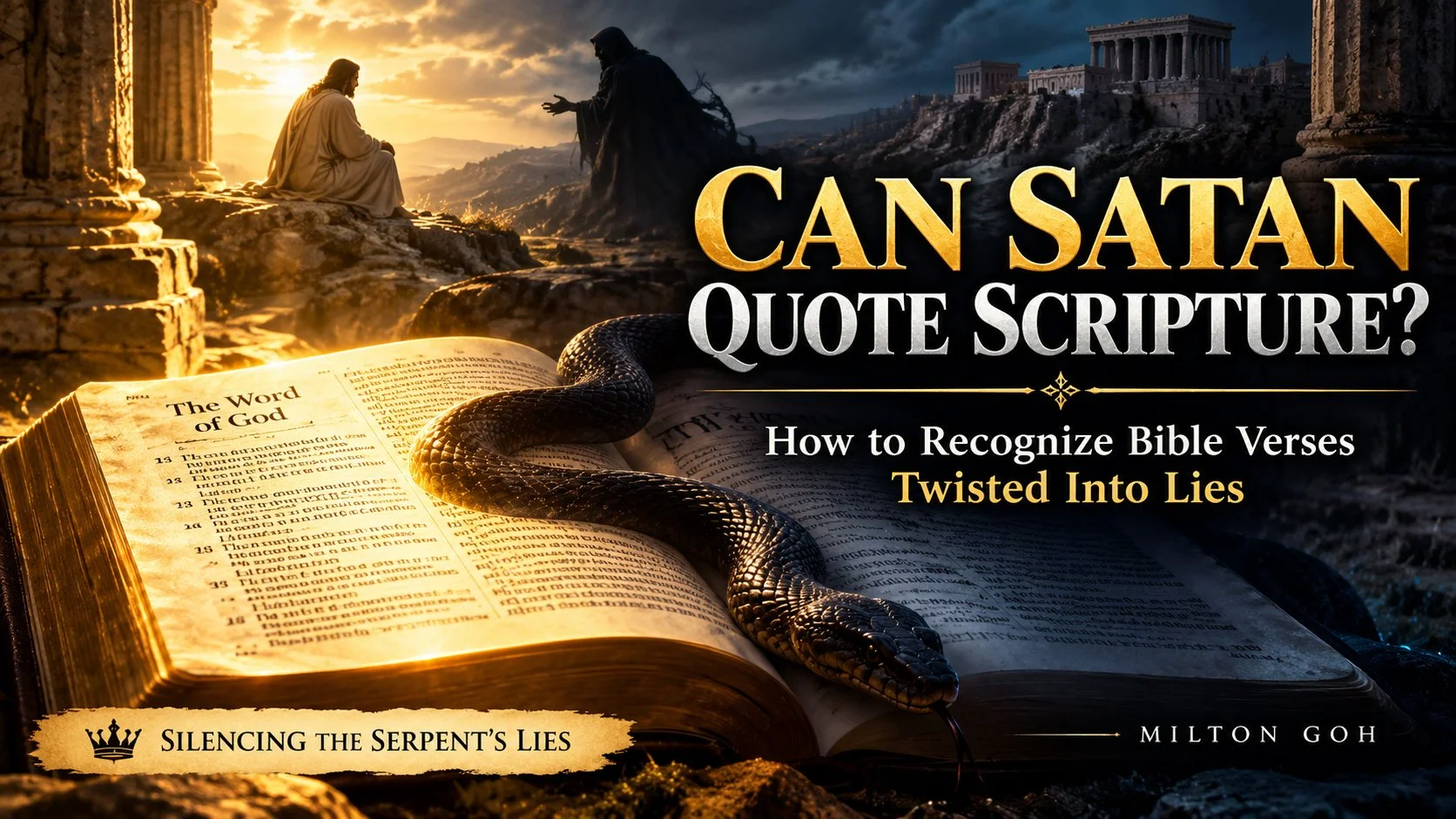
Silencing the Serpent’s Lies — Part 6 | By Milton Goh
Can Satan quote Scripture? Yes. In Luke 4:9–12, the devil quoted Psalm 91 while tempting Jesus in the wilderness. The Bible verses were real, but Satan used them to encourage Jesus to act contrary to the Father’s will. This reveals an important spiritual warfare principle: a statement can contain genuine Scripture and still promote a false conclusion when God’s Word is taken out of context.
Imagine hearing someone say:
“God has promised to protect you. Therefore, you should never have to take any precautions.”
Or:
“The Bible says you can do all things through Christ. Therefore, every dream you pursue must succeed.”
Both statements contain ideas connected to genuine Bible verses.
They sound encouraging. They sound spiritual. They might even stir up excitement in your heart.
But are those conclusions what the Scriptures actually teach?
One of the most dangerous forms of deception is not an obvious rejection of the Bible.
It is the misuse of the Bible itself.
Satan does not always need to persuade someone to stop believing God’s Word. Sometimes, he can exploit a misunderstanding of Scripture to persuade someone to believe something God never actually promised.
That is why spiritual warfare involves more than memorizing Bible verses.
We must also learn to understand them correctly.
Did Satan Really Quote the Bible When He Tempted Jesus?
Yes, and this is one of the most revealing moments in the Gospels.
In Luke 4, Jesus had been fasting in the wilderness for forty days.
The devil approached Him with several temptations.
When Jesus resisted those temptations by answering with Scripture, Satan changed his approach.
He began quoting Scripture too!
In Luke 4:9–11, the devil brought Jesus to Jerusalem, placed Him on the pinnacle of the temple, and challenged Him to throw Himself down.
Then Satan appealed to Psalm 91.
He quoted God’s promise concerning angelic protection, including these words:
“He will put his angels in charge of you, to guard you”
— Luke 4:10 (WEB)
Think about that for a moment.
Satan was quoting a genuine promise from God’s Word.
Psalm 91 really does describe God’s protection.
Angels really do serve God and minister according to His will.
The promise was not invented by Satan.
The deception was in the conclusion Satan wanted Jesus to draw from that promise.
He wanted Jesus to deliberately place Himself in danger as a way of demanding that the Father demonstrate His protection.
It was a temptation to turn trust into presumption.
Jesus immediately exposed the deception:
“You shall not tempt the Lord your God.”
— Luke 4:12 (WEB)
Jesus answered by referring to Deuteronomy 6:16.
Notice what happened.
Satan quoted Scripture.
Jesus answered with Scripture rightly understood.
The difference was not that Jesus knew a more powerful combination of words.
The difference was that Jesus understood and obeyed His Father’s will.
This is an essential lesson for every Christian who wants to become spiritually discerning.
How Did Satan Twist Psalm 91 Into a Lie?
To understand the deception, we need to examine Psalm 91 itself.
Psalm 91 describes the safety, refuge, and protection found in trusting the Lord.
The psalmist speaks of dwelling in the secret place of the Most High, trusting God as a fortress, and receiving His protection.
Verses 11–12 describe angelic assistance.
However, Psalm 91 was never meant to encourage people to manufacture dangerous situations simply to test whether God would rescue them.
There is an enormous difference between trusting God when danger comes and deliberately creating danger to demand a supernatural demonstration.
Consider this example.
A Christian who prays for God’s protection before traveling is expressing dependence on the Lord.
But someone who intentionally drives recklessly because Psalm 91 promises protection is misusing Scripture.
God’s ability to protect us does not make wisdom unnecessary.
In fact, biblical wisdom teaches us to make prudent decisions.
The devil wanted Jesus to act as though the Father’s love needed to be proven through a dramatic spectacle.
But Jesus already knew His Father’s love.
Shortly before the wilderness temptation, the Father had publicly affirmed Jesus as His beloved Son at His baptism (Luke 3:22).
Jesus did not need to jump from a building to establish His identity.
He could simply trust what the Father had already declared.
That is the heart of biblical faith.
Faith trusts God’s revealed Word. Presumption attempts to make God prove Himself on our terms.
Why Is Scripture Taken Out of Context So Dangerous?
Because people may mistake a human interpretation for a divine promise.
When someone says, “The Bible says…” it naturally carries authority among Christians.
After all, we believe that Scripture is inspired by God.
But we must distinguish between two very different things:
What the Bible actually says.
What someone claims a Bible verse means.
Those are not automatically identical.
An interpretation may sound inspiring, dramatic, or persuasive while still missing the intention of the passage.
Peter warned that some people distort difficult passages of Scripture.
In 2 Peter 3:16, he described people who twist Paul’s writings and other Scriptures.
This tells us that the misuse of Scripture was already a serious concern during the early church.
Today, the problem can spread particularly quickly.
A thirty-second video may contain a dramatic statement, a Bible verse appearing on the screen, and an emotional soundtrack.
Someone might share it with thousands of others without checking whether the verse actually supports the message.
The presentation may be convincing.
But an impressive presentation does not guarantee sound interpretation.
Neither does the popularity of the person delivering the message.
The Christian’s responsibility is not to become suspicious of everyone.
It is to love the truth enough to examine what we hear.
Three Examples of Bible Verses That Can Be Misused
Let me show you how this works with some familiar passages.
1. Psalm 91: God’s Protection Does Not Mean You Should Test Him
We have already examined Satan’s use of Psalm 91 in Luke 4.
The false conclusion is:
“Because God promises protection, I can deliberately expose myself to danger and demand that He save me.”
The biblical truth is:
God is our refuge. We can pray confidently for His protection, make wise choices, and trust His care without deliberately testing Him.
Psalm 91 should strengthen our confidence in God, not encourage reckless behavior.
2. Philippians 4:13: Christ’s Strength Is More Than Guaranteed Personal Success
This is one of the most frequently quoted Bible verses.
“I can do all things through Christ, who strengthens me.”
— Philippians 4:13 (WEB)
It is a wonderful verse!
But sometimes people interpret it as though Paul were saying:
“Whatever I decide to accomplish, God guarantees that I will succeed.”
Read the surrounding verses.
In Philippians 4:11–12, Paul explains that he has learned to be content in various circumstances.
He knows what it means to have abundance.
He also knows what it means to experience need.
The context is about Christ strengthening him to remain faithful and content regardless of his circumstances.
It is not a promise that every business, career plan, sporting event, or personal ambition will result in victory.
Does that mean we should stop praying for success?
Certainly not!
We can pray for wisdom, opportunities, provision, favor, and fruitful work.
But we must distinguish between confidently asking God for something and claiming that He has unconditionally guaranteed a particular earthly outcome.
The beautiful truth of Philippians 4:13 is that Christ’s strength is available in seasons of abundance and in seasons of lack.
You do not lose access to His grace when life becomes difficult.
3. 1 John 4:4: Victory in Christ Does Not Mean Spiritual Discernment Is Unnecessary
Another precious verse is:
“Greater is he who is in you than he who is in the world.”
— 1 John 4:4 (WEB)
This is a powerful reminder that God’s Spirit is greater than the enemy.
However, imagine someone concluding:
“Since the Holy Spirit lives in me, it is impossible for me to be deceived. I never need to examine what anyone teaches.”
That would contradict the very chapter containing the verse!
In 1 John 4:1, John instructs believers to test spiritual claims because false prophets have gone out into the world.
The assurance of verse 4 appears in the context of discerning truth from error.
John is not telling Christians to abandon discernment.
He is encouraging them that they belong to God and are not defenseless against deception.
We can be confident in the Holy Spirit’s presence while remaining humble enough to examine our beliefs against Scripture.
Confidence in Christ should make us courageous, not careless.
How Can Christians Recognize Scripture That Has Been Twisted?
Here are six practical questions I recommend asking whenever you encounter a Bible teaching that seems unfamiliar, unusually dramatic, or difficult to reconcile with the Gospel.
1. What Do the Verses Before and After It Say?
Never assume you understand a passage merely because you have read one sentence.
Read the entire paragraph.
Sometimes you may need to read the whole chapter.
Ask yourself:
What subject is the biblical author discussing?
What problem is being addressed?
How does this verse contribute to the surrounding argument?
This simple habit can prevent many misunderstandings.
For example, Philippians 4:13 becomes clearer when you read Paul’s words about contentment immediately before it.
Context helps us understand what the author intended to communicate.
2. Who Was Speaking, and Who Was the Original Audience?
This question is particularly important when reading historical narratives and Old Testament promises.
Not every instruction given to a particular person in Scripture is a direct command to every Christian today.
For example, God instructed Noah to build an ark.
That was a genuine command from God.
But it does not mean every Christian must build an ark!
The account teaches us about God’s holiness, judgment, grace, and Noah’s faith.
However, we should not confuse a unique historical instruction with a universal Christian obligation.
Likewise, a promise made to Israel under a particular covenant must be understood in its historical setting before we consider how it applies to believers in Christ.
Reading Scripture responsibly does not weaken our faith.
It protects us from claiming things God did not actually say.
3. Does the Interpretation Agree With the Rest of Scripture?
God’s Word is not a collection of isolated slogans.
The Scriptures form a unified testimony that ultimately directs us to Jesus Christ.
We should therefore be careful about interpretations that make one verse contradict the clear teaching of another.
This was exactly how Jesus responded to Satan’s misuse of Psalm 91.
He did not deny the promise.
He showed that the proposed action contradicted God’s command not to test Him.
The wider teaching of Scripture helped expose the false application.
A sound interpretation should be able to withstand careful comparison with other relevant passages.
4. Does the Teaching Keep Jesus and His Finished Work Central?
This question is especially important to me.
The Gospel announces that Jesus died for our sins, rose from the dead, and reconciles believers to God through His finished work.
We are saved by grace through faith, not by our ability to perform enough religious works.
Any spiritual teaching that ultimately replaces confidence in Jesus with confidence in our own spiritual performance needs careful examination.
We should not be persuaded that we need secret knowledge, complicated rituals, or extraordinary personal achievements to complete what Jesus has already accomplished for our redemption.
At the same time, the grace of God never turns obedience into something meaningless.
Jesus redeemed us so that we could belong to Him and walk in newness of life.
The Gospel guards us from two opposite errors:
Trying to earn acceptance with God through our works.
And treating the grace of God as permission to disregard His ways.
The New Covenant gives us something better than either extreme.
We are accepted through Christ and transformed by the Holy Spirit.
5. What Is the Teaching Asking Me to Believe or Do?
This is where spiritual discernment becomes practical.
A person may quote a genuine verse and then attach a conclusion that does not follow from it.
Pause and ask:
“Does this verse actually support the action I am being encouraged to take?”
For example:
If a teaching uses God’s provision as a reason to make an irresponsible financial decision, does the passage truly authorize that decision?
If someone uses God’s protection as an excuse to ignore reasonable safety measures, is that faith or presumption?
If a teacher claims that questioning his interpretation means questioning God, is he helping you understand Scripture or placing his own authority beyond examination?
Do not become so impressed by the presence of Bible quotations that you stop considering the conclusions being drawn from them.
God gave you His Word so that you could know Him and walk in truth.
6. Can I Examine This Teaching With Mature Believers?
God has placed us in the body of Christ.
We were not designed to grow in isolation.
Acts 17:11 praises the Bereans because they received the message eagerly while examining the Scriptures daily to see whether the teaching was true.
Notice their attitude.
They were receptive.
But they were also discerning.
They did not reject the message simply because it was new to them.
Neither did they accept it without examination.
They investigated it through God’s Word.
We can follow their example.
When you encounter a difficult teaching, read the passage for yourself.
Study the context.
Discuss it with trustworthy, mature Christian teachers and fellow believers.
Be willing to learn.
And remain willing to correct your understanding when Scripture makes something clearer.
Spiritual maturity is not the belief that you can never be mistaken.
It includes the humility to keep learning from God.
Does Every Incorrect Bible Interpretation Come From Satan?
No.
This distinction is very important.
A Christian may misunderstand a Bible verse because of limited knowledge, an incorrect assumption, an unfamiliar historical context, or simply a mistake.
Not every interpretive error is a deliberate deception.
And we should not automatically accuse someone of being influenced by demons just because we disagree with his or her interpretation.
Scripture calls us to examine teachings carefully, correct error faithfully, and treat people with appropriate gentleness.
There are false teachers who deliberately exploit people.
There are also sincere believers who need better instruction.
Those situations require discernment rather than an indiscriminate accusation.
Remember that our warfare is not against flesh and blood (Ephesians 6:12).
The goal is not to turn every theological disagreement into a spiritual battle against another person.
The goal is to protect the truth of the Gospel and help people come to know Jesus more accurately.
We should be firm about essential truths while remaining humble about questions on which faithful Christians may reasonably differ.
Jesus Shows Us How to Answer Religious Deception
Return with me to the wilderness.
Satan had presented a tempting proposal.
He quoted Scripture to support it.
Yet Jesus did not become confused.
He did not need to argue endlessly.
He answered with the truth of God’s Word and refused the temptation.
This teaches us something beautiful about the strength available to believers.
We do not need to be terrified that the enemy might somehow manipulate every Bible verse we read.
The Holy Spirit is our Helper.
Jesus promised that the Spirit of truth would guide His disciples, and He continues to lead believers toward the truth revealed in Christ.
As we study Scripture, learn sound doctrine, pray, and receive wise teaching, our discernment can grow.
The more familiar we become with the genuine message of God’s Word, the more easily we can recognize interpretations that distort it.
You do not need to know every possible lie in advance.
You need to become established in the truth.
A Simple Prayer for Spiritual Discernment
Heavenly Father,
Thank You for giving me Your precious Word.
Thank You that Jesus is the truth and that Your Holy Spirit leads me toward Him.
Teach me to understand the Scriptures accurately and to recognize when a genuine Bible verse is being used to support a false conclusion.
Give me humility to receive correction, wisdom to discern what is right, and courage to refuse teachings that contradict Your revealed truth.
Keep my heart established in Your grace, Your love, and the finished work of Jesus Christ.
I do not want to become fearful or suspicious of everyone around me.
I want to grow in my knowledge of You.
Thank You that I belong to Jesus, and that You are faithful to guide me as I walk with You.
In Jesus’ name, Amen.
Frequently Asked Questions About Satan and Scripture
Can Satan quote Bible verses?
Yes. Luke 4:9–12 records Satan quoting Psalm 91 while tempting Jesus. This shows that quoting an authentic Bible verse does not automatically make an interpretation or application correct.
Did Satan misquote Psalm 91?
Satan quoted genuine words from Psalm 91, although Luke does not reproduce the complete wording of the psalm. His decisive deception was using the promise of angelic protection to encourage Jesus to test God by deliberately throwing Himself from the temple.
How can I recognize false teaching in Christianity?
Examine the teaching in its biblical context, compare it with the rest of Scripture, consider whether it accurately represents Jesus Christ and His Gospel, and seek wisdom from trustworthy Christian leaders. Do not judge a teaching solely by its emotional impact or the confidence of its speaker.
What does it mean to test the spirits in 1 John 4:1?
John instructed Christians to examine spiritual claims rather than accepting every message as coming from God. In the immediate context, he particularly emphasizes the truth about Jesus Christ coming in the flesh and the importance of remaining faithful to apostolic teaching.
Is memorizing Bible verses enough to resist spiritual deception?
Scripture memorization is valuable, but understanding and applying God’s Word correctly is equally important. Jesus demonstrated this when He answered Satan’s misuse of Psalm 91 with Deuteronomy 6:16. Knowing the words of Scripture should lead us toward understanding and obeying the God who spoke them.
How does the Bible help Christians overcome spiritual deception?
The Scriptures reveal God’s character, the truth of the Gospel, the finished work of Jesus, and the way believers are called to live. As Christians study God’s Word in context and depend upon the Holy Spirit, they become better equipped to recognize false claims and remain faithful to Christ.
Want to Go Deeper? Read Silencing the Serpent
One reason I wrote Silencing the Serpent: How to Overcome the Enemy’s Lies and Stand Victorious in the Truth of God’s Wordwas to help believers recognize spiritual deception without becoming obsessed with the enemy.
Satan’s lies do not always sound obviously evil.
Sometimes they sound reasonable.
Sometimes they appeal to our desires or fears.
And sometimes they even sound religious.
In the definitive revised edition of my book, I explore what Scripture teaches about the enemy’s tactics and how believers can stand firmly in the victory Jesus has already accomplished.
In particular, Chapter 1 examines the serpent’s first temptation in Genesis 3, including how deception can distort what God has said.
Chapter 3, Resisting Temptation with God’s Word, explores Jesus’ wilderness temptation and the importance of understanding Scripture correctly.
The book also examines spiritual strongholds, accusation, the gift of righteousness, spiritual authority, the armor of God, the Holy Spirit’s leading, prayer, and other essential truths for Christian spiritual warfare.
My desire is not for you to become more conscious of Satan.
It is for you to become more established in Jesus.
When you know what God’s Word truly teaches, you become better equipped to recognize the lies that once seemed convincing.
Discover Silencing the Serpent — Definitive Revised Edition
The digital eBook is available through my website, and the paperback edition is available through Amazon.
Final Encouragement: Truth Silences the Serpent
The devil quoted Scripture.
But Jesus knew the Father.
That is the difference I want you to remember.
Christian spiritual warfare is not a competition to see who can recite the most Bible verses.
It is about standing in the truth that God has revealed through Jesus Christ.
When you hear a compelling spiritual claim, do not be afraid to examine it.
Read the surrounding passages.
Consider the context.
Compare the interpretation with the rest of Scripture.
Ask the Holy Spirit for wisdom.
And keep your attention fixed on Jesus.
The enemy may attempt to twist the words of Scripture.
But he cannot change the truth of God’s Word.
You do not need to fear the counterfeit when you are becoming established in the truth.
Keep growing in the grace and knowledge of our Lord Jesus Christ.
Continue reading:
CAN INDIVIDUAL ACTS OF SIN GIVE SATAN A LEGAL RIGHT TO ATTACK ME?
How to Put On the Full Armor of God Every Day: Ephesians 6 Explained
Can a Christian Be Cursed? What the Bible Says About Generational Curses and Witchcraft
Is Every Negative Thought from the devil? How to Discern Lies with God’s Word
How to Silence the Serpent's Lie When You Feel Like You're Not Good Enough.
About the Author
Milton Goh is a Singapore-based Christian author, Bible teacher, and graduate of RHEMA Bible Training Center Singapore’s Diploma of Christian Education and School of Ministry programs.
He serves as Marketing and Outreach Manager at RHEMA Bible Training Center Singapore and shares grace-based Bible teachings, devotionals, Christian books, sermon notes, and faith-building encouragement through his ministry website and online platforms.
He is the author of Silencing the Serpent: How to Overcome the Enemy’s Lies and Stand Victorious in the Truth of God’s Word, a Scripture-centered guide to understanding spiritual warfare and overcoming deception through the finished work of Jesus Christ.
His ministry mission is to Reach More, Teach More, helping believers grow in their knowledge of Jesus and experience the transforming power of God’s grace.
Scripture quotations are from the World English Bible (WEB), public domain.
