

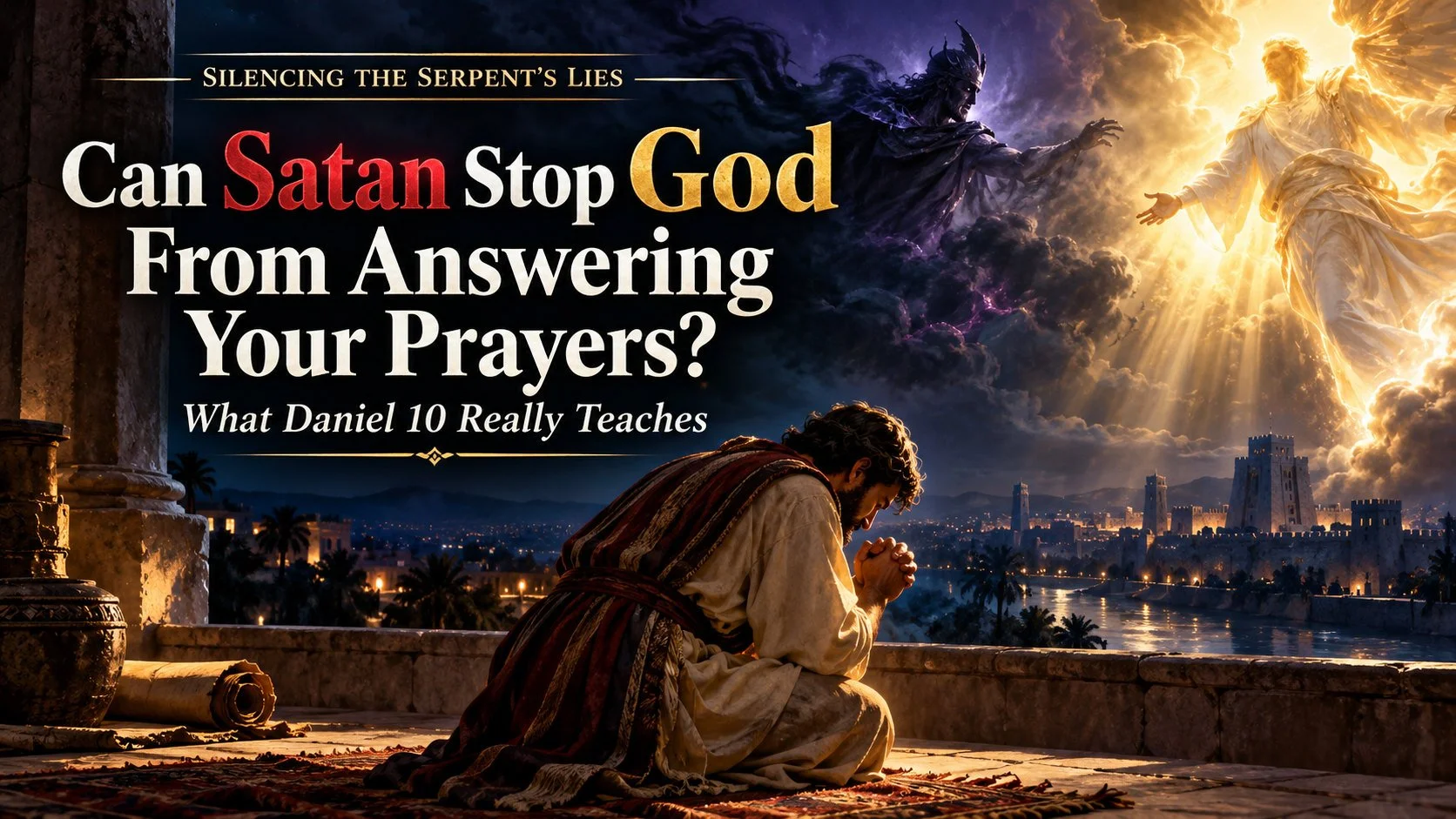
Can Satan Stop God From Answering Your Prayers? Daniel 10 Explained
Can Satan delay answers to prayer? Discover what Daniel 10 reveals about spiritual warfare, the prince of Persia, and praying confidently in Christ.
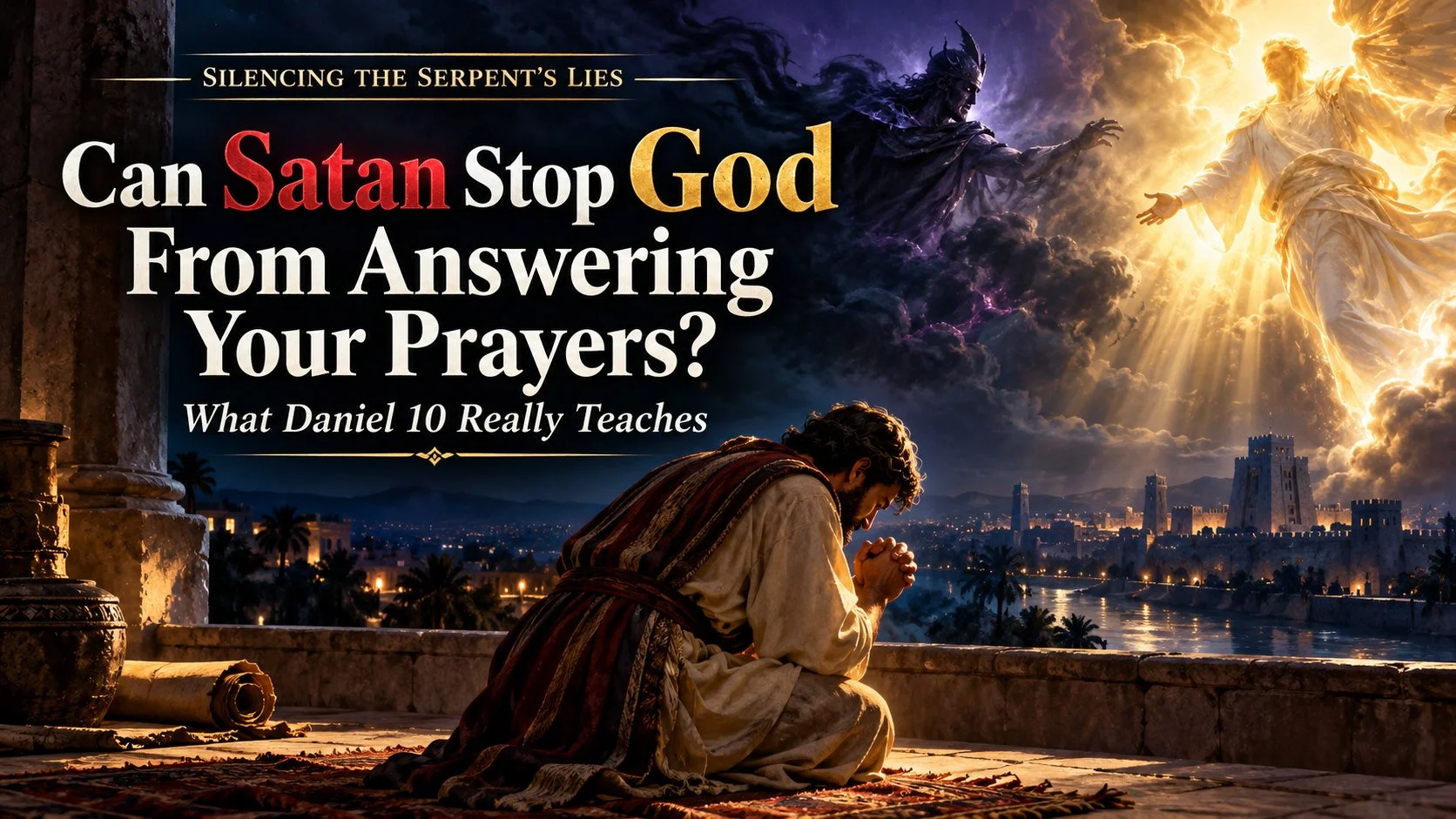
Silencing the Serpent’s Lies — Part 7
By Milton Goh
Have you ever prayed earnestly for something, only to watch the days turn into weeks, or perhaps even months, without seeing the answer you hoped for?
Maybe you prayed for healing, but the symptoms remained.
Maybe you prayed for a loved one to receive salvation, but their heart still seemed hardened toward the Gospel.
Or perhaps you asked God to open a door, provide for an urgent need, or deliver you from a difficult situation, and nothing appeared to change.
Then an unsettling thought entered your mind:
“What if Satan is blocking my prayers from being answered?”
Some Christians become frightened by this possibility. They wonder whether an unseen demonic power is intercepting their prayers, delaying God’s blessings, or preventing their breakthrough.
But is that really what the Bible teaches?
Let’s examine a fascinating passage in Daniel 10 and discover why you do not need to approach prayer with fear.
Can Satan actually stop God from answering prayers?
The short answer is that Satan cannot prevent God from hearing His children or overturn God’s sovereign purposes. However, Daniel 10 reveals that hostile spiritual powers can oppose God’s messengers and that spiritual conflict can accompany an apparent delay in receiving an answer.
The important distinction is between God hearing a prayer and the visible manifestation or communication of an answer.
Daniel 10 describes a heavenly messenger who was delayed for twenty-one days because of spiritual opposition.
Yet Daniel’s prayer had already been heard from the very first day!
This passage reveals that spiritual warfare is real, but it certainly does not teach that Satan is more powerful than God.
Neither does it mean that every delayed answer to prayer is the result of demonic interference.
To understand what happened, we need to examine the biblical account carefully.
Daniel prayed for three weeks before receiving an answer
In Daniel 10, the prophet received a troubling revelation concerning the future of his people.
He responded by mourning, humbling himself before God, and abstaining from certain foods for three full weeks.
Daniel 10:2–3 describes his period of mourning and fasting.
He was seeking understanding from God, but the passage does not describe him as someone attempting to summon angels or fight demons through a special spiritual technique.
After those three weeks, Daniel encountered a heavenly messenger who explained what had been happening.
The messenger told him:
“From the first day that you set your heart to understand, and to humble yourself before your God, your words were heard.”
— Daniel 10:12 (WEB)
Pay attention to those words.
From the first day.
Not the seventh day.
Not the fourteenth day.
Not even the twenty-first day.
Daniel’s prayer was heard from the beginning.
Although he had been waiting three weeks to receive the message, heaven had not been ignoring him.
What seemed like silence from Daniel’s perspective did not mean that God was unwilling to hear him.
Then the messenger explained something remarkable.
Who was the prince of Persia in Daniel 10?
Daniel 10:13 reveals that the messenger encountered opposition from the prince of the kingdom of Persia for twenty-one days.
Michael, described as one of the chief princes, came to assist him.
Who was this mysterious prince of Persia?
Many Bible scholars understand him to be a hostile spiritual ruler associated with the Persian kingdom.
This interpretation makes sense because the passage describes spiritual conflict involving a heavenly messenger and Michael, who is elsewhere identified as an archangel (Jude 1:9).
The passage also mentions a prince of Greece in Daniel 10:20, connecting these spiritual conflicts with the kingdoms involved in Daniel’s prophetic visions.
However, the Bible does not explicitly identify the prince of Persia as Satan himself.
We should therefore avoid confidently assigning names, ranks, territories, or specific activities to demons beyond what Scripture actually reveals.
Here is what the passage makes clear:
A heavenly messenger encountered genuine opposition.
That opposition delayed his arrival.
Michael assisted him.
And God’s message eventually reached Daniel.
Spiritual opposition was real, but it did not have the final word.
Notice also that Daniel was not told to discover the prince’s secret name, identify its territorial jurisdiction, or perform a complicated spiritual-warfare ritual.
The passage directs our attention to God’s purposes, the reality of spiritual conflict, and His faithful provision of help.
The most encouraging detail: God had already heard Daniel
Sometimes we read Daniel 10 and become so fascinated with the prince of Persia that we miss the most encouraging part of the story.
We focus on the demonic opposition rather than God’s attentiveness.
But the messenger did not begin by telling Daniel how powerful the enemy was.
He began by reassuring him that his words had been heard.
What a beautiful reminder of God’s care!
There is an important distinction here.
The messenger’s arrival was delayed, but that does not mean God had to wait twenty-one days before He could hear Daniel’s prayer.
Nor does it mean God had lost control of the situation.
Even when spiritual opposition operates within the world, it remains subordinate to God’s authority.
Now consider something else.
In Daniel 9:20–23, Daniel received an angelic response while he was still praying.
In Daniel 10, he waited three weeks.
The same God was involved in both accounts.
Different experiences of timing did not indicate different levels of divine love.
That matters because Christians can mistakenly judge God’s willingness to hear them according to how quickly their circumstances change.
An immediate answer feels like evidence of God’s favor.
A delayed answer can feel like evidence of His displeasure.
But God’s love is not measured by the number of days between your prayer and its visible answer.
For believers in Christ, the ultimate demonstration of God’s love has already been given at the cross.
Romans 8:32 reminds us that God did not spare His own Son but delivered Him up for us.
When you are unsure about your circumstances, return to what Jesus has already accomplished.
The cross reveals the Father’s heart more clearly than the speed of any particular answered prayer.
Does every delayed answer mean a demon is blocking it?
No.
This is where we must be especially careful.
Daniel 10 reveals one particular instance in which a heavenly messenger was delayed by spiritual opposition.
It does not provide a universal explanation for every unanswered prayer.
We cannot look at someone who has been praying for healing for six months and confidently announce that a demon has been intercepting the answer.
Neither can we assume that a Christian who has been unemployed for a prolonged period must be facing a powerful territorial spirit.
The Bible gives us no basis for making those diagnoses simply from the length of a delay.
In fact, Scripture shows that believers may encounter delays, hardship, and unanswered questions for different reasons.
Sometimes circumstances involve human decisions.
Sometimes difficulties arise because we live in a fallen world.
Sometimes God is doing something that we do not yet understand.
And the New Testament does acknowledge genuine spiritual opposition.
For example, Paul wrote in 1 Thessalonians 2:18 that Satan hindered him and his companions from returning to Thessalonica.
That is a real example of satanic hindrance.
However, it concerns an attempted ministry journey, not the interception of someone’s prayers.
We must distinguish between what Scripture explicitly teaches and the conclusions we might be tempted to draw.
When the reason for a delay is not revealed, we should resist the urge to invent one.
A delayed answer is not enough evidence to conclude that Satan is blocking you, that your faith is insufficient, or that God has rejected your request.
Did Daniel’s twenty-one-day fast defeat the demonic prince?
This is another important question because some Christians associate Daniel 10 with the idea that fasting for exactly twenty-one days will break spiritual resistance.
Daniel did fast and humble himself before God during those three weeks.
His devotion was sincere and meaningful.
However, Scripture does not say that the number twenty-one carries a special spiritual power.
Neither does it say that Daniel’s fasting eventually accumulated enough spiritual force to defeat the prince of Persia.
The passage explicitly mentions Michael coming to help the heavenly messenger.
It does not teach that fasting functions like a weapon whose effectiveness increases automatically with the number of days completed.
Fasting is a valuable biblical practice.
It can help us set aside ordinary comforts to devote focused attention to prayer, worship, repentance, and seeking God’s direction.
But fasting does not purchase God’s favor.
It does not make God more willing to love us.
And it should never become a spiritual performance through which we attempt to earn the right to receive His help.
Under the New Covenant, our confidence before God rests upon Jesus Christ and His finished work.
You can fast as the Holy Spirit leads you, but you do not have to wait until you have accumulated enough fasting hours before believing that your Father welcomes your prayers.
Jesus has already opened the way for you to approach the Father
Here is where the Gospel changes how we understand spiritual warfare.
Under the Old Covenant, the prophet Daniel lived before the death and resurrection of Jesus Christ.
Today, born-again believers have the extraordinary privilege of approaching God through the risen Lord Jesus.
Hebrews 4:16 invites us to:
“Draw near with boldness to the throne of grace.”
— Hebrews 4:16 (WEB)
Why can we approach God’s throne boldly?
Not because we have defeated every demon.
Not because we have prayed long enough.
Not because we have achieved a perfect record of Christian obedience.
We approach because Jesus is our great High Priest.
Hebrews 7:25 teaches that He lives to make intercession for those who draw near to God through Him.
Romans 8:34 likewise declares that the risen Christ intercedes for us at God’s right hand.
And Romans 8:26–27 teaches that the Holy Spirit helps us in our weakness and intercedes according to God’s will.
Consider how reassuring that is.
You are not trying to persuade a distant God to pay attention while Satan attempts to intercept your words.
You have a Savior who has reconciled you to the Father.
You have the Holy Spirit helping you in your weakness.
And you have the privilege of approaching the throne of grace.
The foundation of your prayer life is not your ability to overcome spiritual obstacles. It is Jesus’ completed work of redemption.
Satan cannot undo that finished work.
What if Satan tries to discourage you from praying?
There is another form of spiritual opposition that deserves our attention.
Sometimes the enemy’s greatest advantage is not an unseen delay but a lie that convinces believers to stop trusting God.
Imagine that someone has been praying for an important need without seeing any improvement.
Over time, thoughts such as these begin to arise:
“God doesn’t really care about my situation.”
“Maybe He only answers the prayers of more spiritual Christians.”
“Perhaps I have sinned too much for God to help me.”
“Maybe Satan is so powerful that even my prayers cannot get through.”
Notice where these thoughts lead.
They shift attention away from Jesus and onto the believer’s supposed inadequacy or the enemy’s imagined superiority.
This is precisely why knowing God’s Word matters in spiritual warfare.
Ephesians 6 teaches us to stand against the devil’s schemes with the armor God provides, including truth, righteousness, faith, salvation, God’s Word, and persevering prayer.
Paul’s instruction in Ephesians 6:18 is to continue praying in the Spirit.
Spiritual warfare is not a reason to abandon prayer.
It is one reason believers must remain established in God’s truth and continue depending on Him.
When discouraging thoughts arise, ask yourself:
Does this conclusion agree with what Jesus has revealed about the Father?
Does it direct my attention toward Christ and His faithfulness?
Or does it make me increasingly afraid of Satan and doubtful of God’s love?
A thought may sound convincing without being true.
You do not have to accept every frightening explanation that enters your mind.
And you do not have to treat every such thought as a direct message from a demon.
Test what you believe against Scripture.
When a thought contradicts the Gospel, reject the lie and return your attention to Jesus.
How should Christians respond when prayers seem unanswered?
If you are currently waiting for an answer, I want to encourage you to respond from faith rather than fear.
Here are five biblical practices that can help.
Keep approaching God confidently. Hebrews 4:16 invites you to receive mercy and find grace for help in time of need. You do not need to withdraw from God while waiting for circumstances to change.
Continue praying according to His Word. First John 5:14 reminds us that our confidence in prayer is connected to asking according to God’s will. Learn what Scripture promises, ask boldly, and avoid making up guarantees God has not given.
Refuse condemnation and spiritual self-blame. A delayed answer does not automatically reveal personal sin, insufficient faith, or demonic interference. If the Holy Spirit lovingly brings a genuine issue to your attention, respond with repentance. Otherwise, do not manufacture accusations against yourself.
Receive the help God makes available. Prayer and practical action are not enemies. If you are sick, continue seeking appropriate medical care while praying for healing. If you need provision, pursue suitable opportunities and wise counsel. Allow mature believers to pray with you and help carry your burdens.
Remain established in Jesus rather than becoming preoccupied with the enemy. Resist the devil by submitting to God, standing in His truth, refusing temptation, and persevering in faith. You do not need to spend your days investigating invisible demonic activity.
Notice that none of these practices require fear.
They are responses to God’s grace.
They help us keep our hearts focused on the One who loves us and faithfully cares for His people.
What if God’s answer is different from what I expected?
There is another biblical account that helps us understand prayer and spiritual opposition.
In 2 Corinthians 12:7–10, Paul described a painful affliction that he called a messenger of Satan.
He pleaded with the Lord three times that it might depart from him.
The Lord answered him:
“My grace is sufficient for you.”
— 2 Corinthians 12:9 (WEB)
Paul’s experience reminds us that spiritual opposition does not mean God has abandoned His people.
It also teaches us that the Lord may answer a request in a way different from the outcome we initially desired.
God assured Paul of His sufficient grace and power in weakness.
We should not turn Paul’s experience into a universal rule that every affliction must remain, just as we should not turn Daniel’s experience into a universal rule that every delayed answer has been intercepted by a demonic prince.
Each passage teaches us something about God’s faithfulness within its own context.
Together, they help us avoid both extremes.
We do not need to deny the reality of spiritual warfare.
But neither should we exaggerate the enemy’s power or pretend we know the hidden reason behind every difficult season.
We can pray confidently for healing, provision, protection, restoration, and deliverance while continuing to trust our Father’s wisdom.
God’s faithfulness is not dependent on our ability to explain every circumstance.
Frequently Asked Questions About Satan and Unanswered Prayers
Can demons prevent my prayers from reaching heaven?
The Bible does not teach that demons can stop a Christian’s prayers from reaching God. Through Jesus Christ, believers have access to the Father. Daniel 10 describes a messenger encountering opposition, not God being unable to hear a prayer.
Why was the angel delayed for twenty-one days in Daniel 10?
Daniel 10:13 states that the prince of the kingdom of Persia opposed the heavenly messenger for twenty-one days. Michael came to assist him. The passage reveals spiritual conflict, but it does not explain every mechanism involved or establish a universal pattern for answered prayer.
Should Christians fast for twenty-one days to remove spiritual blockages?
A twenty-one-day fast is not presented in Scripture as a guaranteed method of removing demonic interference. Daniel’s fasting expressed mourning and humility before God. Christians may fast prayerfully, but fasting is not a transaction that purchases an answer.
Can Satan interfere with a Christian’s life?
Scripture teaches that Satan can tempt, deceive, accuse, and oppose God’s people. However, he does not have rightful ownership over those who belong to Jesus Christ. Believers are called to submit to God, resist the devil, and stand firm in faith (James 4:7; 1 Peter 5:8–9).
Does an unanswered prayer mean I don’t have enough faith?
Not necessarily. Scripture does not permit us to conclude that every unanswered prayer results from insufficient faith. Paul’s experience in 2 Corinthians 12 shows that even a faithful apostle encountered suffering and received an answer different from the deliverance he requested.
How can I keep trusting God when I have been praying for a long time?
Keep returning to what Scripture reveals about Jesus, His finished work, God’s fatherly care, and the Holy Spirit’s help. Pray honestly, receive support from other believers, take wise practical steps, and refuse to interpret an unexplained delay as proof that God no longer loves you.
Don’t let a delayed answer become a lie about God’s character
Let us return to Daniel one more time.
For three weeks, Daniel waited.
He did not know everything that was happening in the unseen realm.
He could not see the opposition encountered by the heavenly messenger.
But God had heard him from the first day.
I believe this is one of the most encouraging truths we can receive from the passage.
Not that every Christian prayer will receive its answer after twenty-one days.
Not that we must identify the particular demon responsible for every difficulty.
And certainly not that Satan has the ability to overpower God.
The encouragement is that what we can see is not the whole story, and spiritual opposition cannot overturn God’s sovereignty or His faithfulness.
Dear child of God, do not become more conscious of Satan’s activity than you are of Jesus’ finished work.
The enemy may oppose.
Circumstances may remain difficult.
You may not understand why an answer has not yet appeared.
But Jesus remains your risen Savior and faithful High Priest.
Your Father has welcomed you through Him.
The Holy Spirit is present to help you.
And you can continue praying with confidence instead of fear.
Remember this:
A heavenly messenger was delayed in Daniel 10. God was not deaf to Daniel’s prayer.
So refuse the serpent’s lie that an unanswered prayer must mean you have been forgotten, rejected, or defeated.
Keep your eyes on Jesus.
Keep receiving God’s Word.
And keep trusting the Father who loves you.
The enemy does not have the final word over your life.
Jesus does.
Go Deeper into Biblical Spiritual Warfare with Silencing the Serpent
One of the reasons I wrote Silencing the Serpent: How to Overcome the Enemy’s Lies and Stand Victorious in the Truth of God’s Word is to help believers stop approaching spiritual warfare from a position of fear.
The enemy often tries to make his power appear greater than it really is.
He uses deception, accusation, intimidation, and confusion to distract Christians from what Jesus has already accomplished through His death and resurrection.
But God’s Word reveals a far better reality.
In my book, I explore how believers can recognize the enemy’s schemes, stand in their righteousness in Christ, pray confidently in Jesus’ name, resist temptation, understand the ministry of angels, and walk victoriously by the Holy Spirit.
The goal is not to make you more fascinated with darkness.
It is to help you become more established in the truth about Jesus Christ.
If you want to deepen your understanding of biblical spiritual warfare while remaining grounded in God’s grace and the finished work of Jesus, I invite you to read the definitive revised edition.
Discover Silencing the Serpent and get your copy here.
You do not need to fear the serpent’s lies when you know the truth of God’s Word.
Milton Goh is a Christian author, Bible teacher, and graduate of RHEMA Bible Training Center Singapore who writes about God’s grace, righteousness in Christ, faith, and victorious Christian living.
Related reading:
CAN SATAN STOP GOD FROM ANSWERING YOUR PRAYERS? DANIEL 10 EXPLAINED
CAN SATAN QUOTE SCRIPTURE? HOW TO RECOGNIZE BIBLE VERSES TWISTED INTO LIES
CAN INDIVIDUAL ACTS OF SIN GIVE SATAN A LEGAL RIGHT TO ATTACK ME?
How to Put On the Full Armor of God Every Day: Ephesians 6 Explained
Can a Christian Be Cursed? What the Bible Says About Generational Curses and Witchcraft
Is Every Negative Thought from the devil? How to Discern Lies with God’s Word
How to Silence the Serpent's Lie When You Feel Like You're Not Good Enough
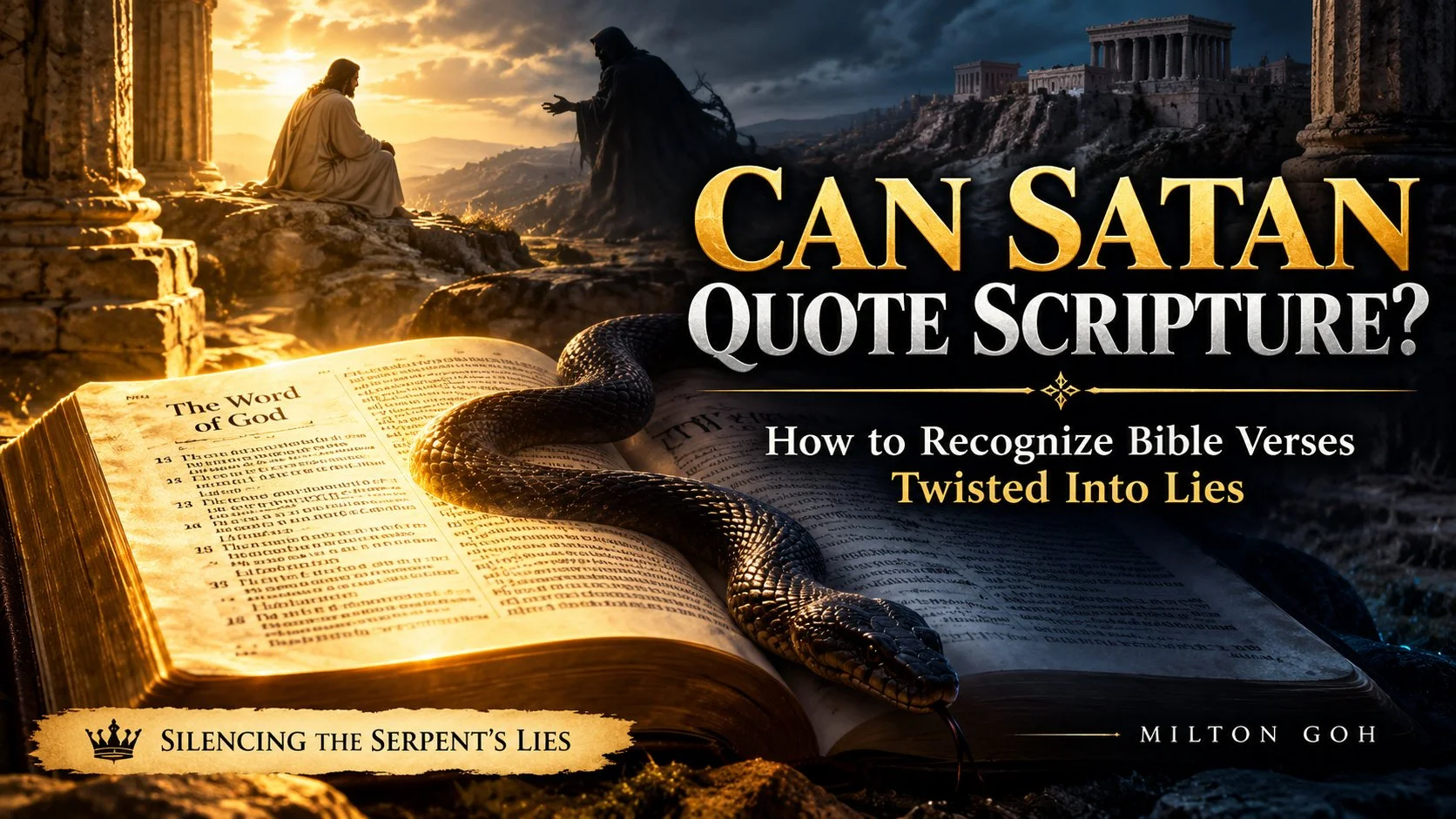
Can Satan Quote Scripture? How to Recognize Bible Verses Twisted Into Lies
Discover how Satan twisted Scripture when tempting Jesus, how to recognize Bible verses taken out of context, and how God's Word protects you from deception.
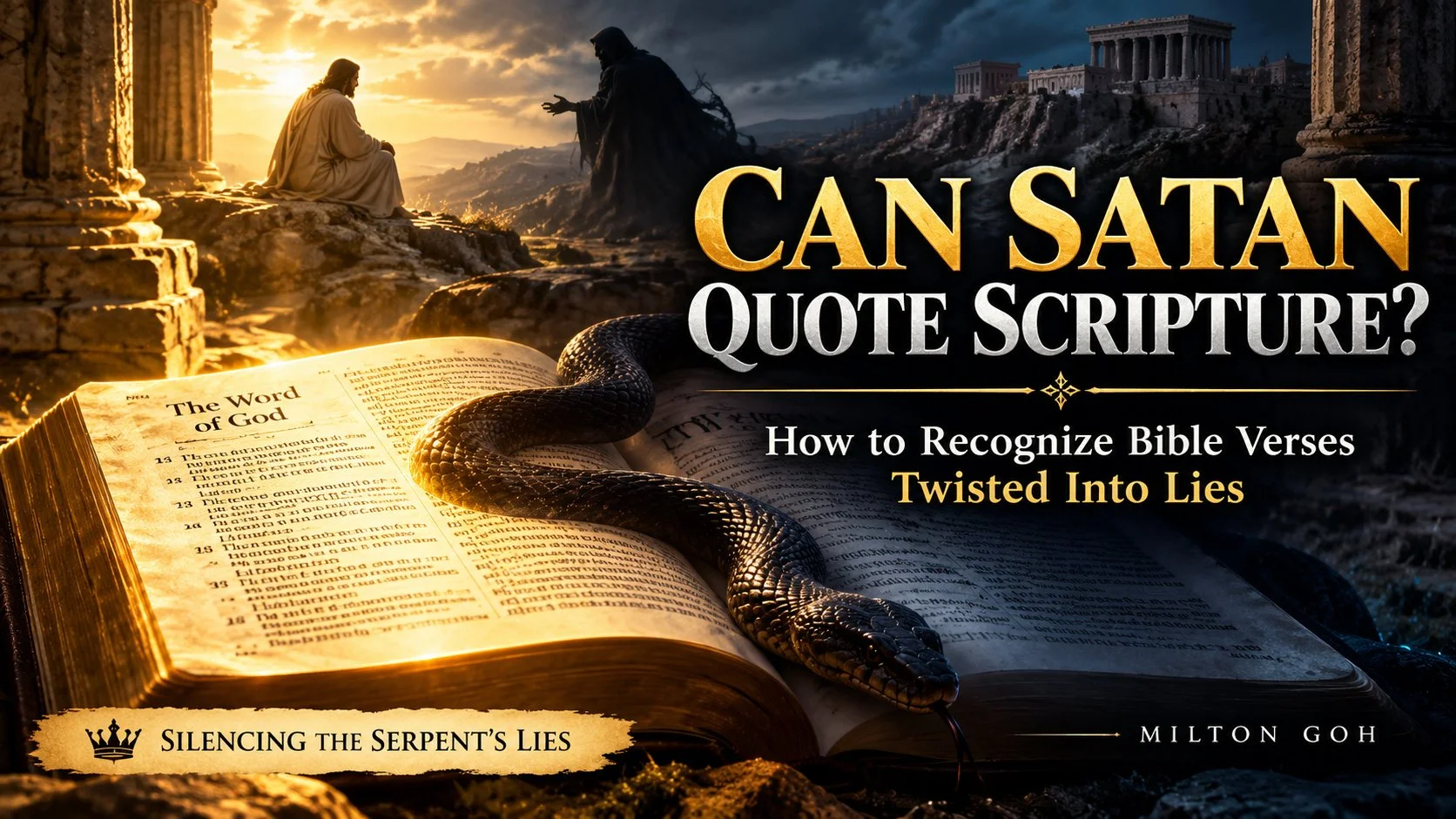
Silencing the Serpent’s Lies — Part 6 | By Milton Goh
Can Satan quote Scripture? Yes. In Luke 4:9–12, the devil quoted Psalm 91 while tempting Jesus in the wilderness. The Bible verses were real, but Satan used them to encourage Jesus to act contrary to the Father’s will. This reveals an important spiritual warfare principle: a statement can contain genuine Scripture and still promote a false conclusion when God’s Word is taken out of context.
Imagine hearing someone say:
“God has promised to protect you. Therefore, you should never have to take any precautions.”
Or:
“The Bible says you can do all things through Christ. Therefore, every dream you pursue must succeed.”
Both statements contain ideas connected to genuine Bible verses.
They sound encouraging. They sound spiritual. They might even stir up excitement in your heart.
But are those conclusions what the Scriptures actually teach?
One of the most dangerous forms of deception is not an obvious rejection of the Bible.
It is the misuse of the Bible itself.
Satan does not always need to persuade someone to stop believing God’s Word. Sometimes, he can exploit a misunderstanding of Scripture to persuade someone to believe something God never actually promised.
That is why spiritual warfare involves more than memorizing Bible verses.
We must also learn to understand them correctly.
Did Satan Really Quote the Bible When He Tempted Jesus?
Yes, and this is one of the most revealing moments in the Gospels.
In Luke 4, Jesus had been fasting in the wilderness for forty days.
The devil approached Him with several temptations.
When Jesus resisted those temptations by answering with Scripture, Satan changed his approach.
He began quoting Scripture too!
In Luke 4:9–11, the devil brought Jesus to Jerusalem, placed Him on the pinnacle of the temple, and challenged Him to throw Himself down.
Then Satan appealed to Psalm 91.
He quoted God’s promise concerning angelic protection, including these words:
“He will put his angels in charge of you, to guard you”
— Luke 4:10 (WEB)
Think about that for a moment.
Satan was quoting a genuine promise from God’s Word.
Psalm 91 really does describe God’s protection.
Angels really do serve God and minister according to His will.
The promise was not invented by Satan.
The deception was in the conclusion Satan wanted Jesus to draw from that promise.
He wanted Jesus to deliberately place Himself in danger as a way of demanding that the Father demonstrate His protection.
It was a temptation to turn trust into presumption.
Jesus immediately exposed the deception:
“You shall not tempt the Lord your God.”
— Luke 4:12 (WEB)
Jesus answered by referring to Deuteronomy 6:16.
Notice what happened.
Satan quoted Scripture.
Jesus answered with Scripture rightly understood.
The difference was not that Jesus knew a more powerful combination of words.
The difference was that Jesus understood and obeyed His Father’s will.
This is an essential lesson for every Christian who wants to become spiritually discerning.
How Did Satan Twist Psalm 91 Into a Lie?
To understand the deception, we need to examine Psalm 91 itself.
Psalm 91 describes the safety, refuge, and protection found in trusting the Lord.
The psalmist speaks of dwelling in the secret place of the Most High, trusting God as a fortress, and receiving His protection.
Verses 11–12 describe angelic assistance.
However, Psalm 91 was never meant to encourage people to manufacture dangerous situations simply to test whether God would rescue them.
There is an enormous difference between trusting God when danger comes and deliberately creating danger to demand a supernatural demonstration.
Consider this example.
A Christian who prays for God’s protection before traveling is expressing dependence on the Lord.
But someone who intentionally drives recklessly because Psalm 91 promises protection is misusing Scripture.
God’s ability to protect us does not make wisdom unnecessary.
In fact, biblical wisdom teaches us to make prudent decisions.
The devil wanted Jesus to act as though the Father’s love needed to be proven through a dramatic spectacle.
But Jesus already knew His Father’s love.
Shortly before the wilderness temptation, the Father had publicly affirmed Jesus as His beloved Son at His baptism (Luke 3:22).
Jesus did not need to jump from a building to establish His identity.
He could simply trust what the Father had already declared.
That is the heart of biblical faith.
Faith trusts God’s revealed Word. Presumption attempts to make God prove Himself on our terms.
Why Is Scripture Taken Out of Context So Dangerous?
Because people may mistake a human interpretation for a divine promise.
When someone says, “The Bible says…” it naturally carries authority among Christians.
After all, we believe that Scripture is inspired by God.
But we must distinguish between two very different things:
What the Bible actually says.
What someone claims a Bible verse means.
Those are not automatically identical.
An interpretation may sound inspiring, dramatic, or persuasive while still missing the intention of the passage.
Peter warned that some people distort difficult passages of Scripture.
In 2 Peter 3:16, he described people who twist Paul’s writings and other Scriptures.
This tells us that the misuse of Scripture was already a serious concern during the early church.
Today, the problem can spread particularly quickly.
A thirty-second video may contain a dramatic statement, a Bible verse appearing on the screen, and an emotional soundtrack.
Someone might share it with thousands of others without checking whether the verse actually supports the message.
The presentation may be convincing.
But an impressive presentation does not guarantee sound interpretation.
Neither does the popularity of the person delivering the message.
The Christian’s responsibility is not to become suspicious of everyone.
It is to love the truth enough to examine what we hear.
Three Examples of Bible Verses That Can Be Misused
Let me show you how this works with some familiar passages.
1. Psalm 91: God’s Protection Does Not Mean You Should Test Him
We have already examined Satan’s use of Psalm 91 in Luke 4.
The false conclusion is:
“Because God promises protection, I can deliberately expose myself to danger and demand that He save me.”
The biblical truth is:
God is our refuge. We can pray confidently for His protection, make wise choices, and trust His care without deliberately testing Him.
Psalm 91 should strengthen our confidence in God, not encourage reckless behavior.
2. Philippians 4:13: Christ’s Strength Is More Than Guaranteed Personal Success
This is one of the most frequently quoted Bible verses.
“I can do all things through Christ, who strengthens me.”
— Philippians 4:13 (WEB)
It is a wonderful verse!
But sometimes people interpret it as though Paul were saying:
“Whatever I decide to accomplish, God guarantees that I will succeed.”
Read the surrounding verses.
In Philippians 4:11–12, Paul explains that he has learned to be content in various circumstances.
He knows what it means to have abundance.
He also knows what it means to experience need.
The context is about Christ strengthening him to remain faithful and content regardless of his circumstances.
It is not a promise that every business, career plan, sporting event, or personal ambition will result in victory.
Does that mean we should stop praying for success?
Certainly not!
We can pray for wisdom, opportunities, provision, favor, and fruitful work.
But we must distinguish between confidently asking God for something and claiming that He has unconditionally guaranteed a particular earthly outcome.
The beautiful truth of Philippians 4:13 is that Christ’s strength is available in seasons of abundance and in seasons of lack.
You do not lose access to His grace when life becomes difficult.
3. 1 John 4:4: Victory in Christ Does Not Mean Spiritual Discernment Is Unnecessary
Another precious verse is:
“Greater is he who is in you than he who is in the world.”
— 1 John 4:4 (WEB)
This is a powerful reminder that God’s Spirit is greater than the enemy.
However, imagine someone concluding:
“Since the Holy Spirit lives in me, it is impossible for me to be deceived. I never need to examine what anyone teaches.”
That would contradict the very chapter containing the verse!
In 1 John 4:1, John instructs believers to test spiritual claims because false prophets have gone out into the world.
The assurance of verse 4 appears in the context of discerning truth from error.
John is not telling Christians to abandon discernment.
He is encouraging them that they belong to God and are not defenseless against deception.
We can be confident in the Holy Spirit’s presence while remaining humble enough to examine our beliefs against Scripture.
Confidence in Christ should make us courageous, not careless.
How Can Christians Recognize Scripture That Has Been Twisted?
Here are six practical questions I recommend asking whenever you encounter a Bible teaching that seems unfamiliar, unusually dramatic, or difficult to reconcile with the Gospel.
1. What Do the Verses Before and After It Say?
Never assume you understand a passage merely because you have read one sentence.
Read the entire paragraph.
Sometimes you may need to read the whole chapter.
Ask yourself:
What subject is the biblical author discussing?
What problem is being addressed?
How does this verse contribute to the surrounding argument?
This simple habit can prevent many misunderstandings.
For example, Philippians 4:13 becomes clearer when you read Paul’s words about contentment immediately before it.
Context helps us understand what the author intended to communicate.
2. Who Was Speaking, and Who Was the Original Audience?
This question is particularly important when reading historical narratives and Old Testament promises.
Not every instruction given to a particular person in Scripture is a direct command to every Christian today.
For example, God instructed Noah to build an ark.
That was a genuine command from God.
But it does not mean every Christian must build an ark!
The account teaches us about God’s holiness, judgment, grace, and Noah’s faith.
However, we should not confuse a unique historical instruction with a universal Christian obligation.
Likewise, a promise made to Israel under a particular covenant must be understood in its historical setting before we consider how it applies to believers in Christ.
Reading Scripture responsibly does not weaken our faith.
It protects us from claiming things God did not actually say.
3. Does the Interpretation Agree With the Rest of Scripture?
God’s Word is not a collection of isolated slogans.
The Scriptures form a unified testimony that ultimately directs us to Jesus Christ.
We should therefore be careful about interpretations that make one verse contradict the clear teaching of another.
This was exactly how Jesus responded to Satan’s misuse of Psalm 91.
He did not deny the promise.
He showed that the proposed action contradicted God’s command not to test Him.
The wider teaching of Scripture helped expose the false application.
A sound interpretation should be able to withstand careful comparison with other relevant passages.
4. Does the Teaching Keep Jesus and His Finished Work Central?
This question is especially important to me.
The Gospel announces that Jesus died for our sins, rose from the dead, and reconciles believers to God through His finished work.
We are saved by grace through faith, not by our ability to perform enough religious works.
Any spiritual teaching that ultimately replaces confidence in Jesus with confidence in our own spiritual performance needs careful examination.
We should not be persuaded that we need secret knowledge, complicated rituals, or extraordinary personal achievements to complete what Jesus has already accomplished for our redemption.
At the same time, the grace of God never turns obedience into something meaningless.
Jesus redeemed us so that we could belong to Him and walk in newness of life.
The Gospel guards us from two opposite errors:
Trying to earn acceptance with God through our works.
And treating the grace of God as permission to disregard His ways.
The New Covenant gives us something better than either extreme.
We are accepted through Christ and transformed by the Holy Spirit.
5. What Is the Teaching Asking Me to Believe or Do?
This is where spiritual discernment becomes practical.
A person may quote a genuine verse and then attach a conclusion that does not follow from it.
Pause and ask:
“Does this verse actually support the action I am being encouraged to take?”
For example:
If a teaching uses God’s provision as a reason to make an irresponsible financial decision, does the passage truly authorize that decision?
If someone uses God’s protection as an excuse to ignore reasonable safety measures, is that faith or presumption?
If a teacher claims that questioning his interpretation means questioning God, is he helping you understand Scripture or placing his own authority beyond examination?
Do not become so impressed by the presence of Bible quotations that you stop considering the conclusions being drawn from them.
God gave you His Word so that you could know Him and walk in truth.
6. Can I Examine This Teaching With Mature Believers?
God has placed us in the body of Christ.
We were not designed to grow in isolation.
Acts 17:11 praises the Bereans because they received the message eagerly while examining the Scriptures daily to see whether the teaching was true.
Notice their attitude.
They were receptive.
But they were also discerning.
They did not reject the message simply because it was new to them.
Neither did they accept it without examination.
They investigated it through God’s Word.
We can follow their example.
When you encounter a difficult teaching, read the passage for yourself.
Study the context.
Discuss it with trustworthy, mature Christian teachers and fellow believers.
Be willing to learn.
And remain willing to correct your understanding when Scripture makes something clearer.
Spiritual maturity is not the belief that you can never be mistaken.
It includes the humility to keep learning from God.
Does Every Incorrect Bible Interpretation Come From Satan?
No.
This distinction is very important.
A Christian may misunderstand a Bible verse because of limited knowledge, an incorrect assumption, an unfamiliar historical context, or simply a mistake.
Not every interpretive error is a deliberate deception.
And we should not automatically accuse someone of being influenced by demons just because we disagree with his or her interpretation.
Scripture calls us to examine teachings carefully, correct error faithfully, and treat people with appropriate gentleness.
There are false teachers who deliberately exploit people.
There are also sincere believers who need better instruction.
Those situations require discernment rather than an indiscriminate accusation.
Remember that our warfare is not against flesh and blood (Ephesians 6:12).
The goal is not to turn every theological disagreement into a spiritual battle against another person.
The goal is to protect the truth of the Gospel and help people come to know Jesus more accurately.
We should be firm about essential truths while remaining humble about questions on which faithful Christians may reasonably differ.
Jesus Shows Us How to Answer Religious Deception
Return with me to the wilderness.
Satan had presented a tempting proposal.
He quoted Scripture to support it.
Yet Jesus did not become confused.
He did not need to argue endlessly.
He answered with the truth of God’s Word and refused the temptation.
This teaches us something beautiful about the strength available to believers.
We do not need to be terrified that the enemy might somehow manipulate every Bible verse we read.
The Holy Spirit is our Helper.
Jesus promised that the Spirit of truth would guide His disciples, and He continues to lead believers toward the truth revealed in Christ.
As we study Scripture, learn sound doctrine, pray, and receive wise teaching, our discernment can grow.
The more familiar we become with the genuine message of God’s Word, the more easily we can recognize interpretations that distort it.
You do not need to know every possible lie in advance.
You need to become established in the truth.
A Simple Prayer for Spiritual Discernment
Heavenly Father,
Thank You for giving me Your precious Word.
Thank You that Jesus is the truth and that Your Holy Spirit leads me toward Him.
Teach me to understand the Scriptures accurately and to recognize when a genuine Bible verse is being used to support a false conclusion.
Give me humility to receive correction, wisdom to discern what is right, and courage to refuse teachings that contradict Your revealed truth.
Keep my heart established in Your grace, Your love, and the finished work of Jesus Christ.
I do not want to become fearful or suspicious of everyone around me.
I want to grow in my knowledge of You.
Thank You that I belong to Jesus, and that You are faithful to guide me as I walk with You.
In Jesus’ name, Amen.
Frequently Asked Questions About Satan and Scripture
Can Satan quote Bible verses?
Yes. Luke 4:9–12 records Satan quoting Psalm 91 while tempting Jesus. This shows that quoting an authentic Bible verse does not automatically make an interpretation or application correct.
Did Satan misquote Psalm 91?
Satan quoted genuine words from Psalm 91, although Luke does not reproduce the complete wording of the psalm. His decisive deception was using the promise of angelic protection to encourage Jesus to test God by deliberately throwing Himself from the temple.
How can I recognize false teaching in Christianity?
Examine the teaching in its biblical context, compare it with the rest of Scripture, consider whether it accurately represents Jesus Christ and His Gospel, and seek wisdom from trustworthy Christian leaders. Do not judge a teaching solely by its emotional impact or the confidence of its speaker.
What does it mean to test the spirits in 1 John 4:1?
John instructed Christians to examine spiritual claims rather than accepting every message as coming from God. In the immediate context, he particularly emphasizes the truth about Jesus Christ coming in the flesh and the importance of remaining faithful to apostolic teaching.
Is memorizing Bible verses enough to resist spiritual deception?
Scripture memorization is valuable, but understanding and applying God’s Word correctly is equally important. Jesus demonstrated this when He answered Satan’s misuse of Psalm 91 with Deuteronomy 6:16. Knowing the words of Scripture should lead us toward understanding and obeying the God who spoke them.
How does the Bible help Christians overcome spiritual deception?
The Scriptures reveal God’s character, the truth of the Gospel, the finished work of Jesus, and the way believers are called to live. As Christians study God’s Word in context and depend upon the Holy Spirit, they become better equipped to recognize false claims and remain faithful to Christ.
Want to Go Deeper? Read Silencing the Serpent
One reason I wrote Silencing the Serpent: How to Overcome the Enemy’s Lies and Stand Victorious in the Truth of God’s Wordwas to help believers recognize spiritual deception without becoming obsessed with the enemy.
Satan’s lies do not always sound obviously evil.
Sometimes they sound reasonable.
Sometimes they appeal to our desires or fears.
And sometimes they even sound religious.
In the definitive revised edition of my book, I explore what Scripture teaches about the enemy’s tactics and how believers can stand firmly in the victory Jesus has already accomplished.
In particular, Chapter 1 examines the serpent’s first temptation in Genesis 3, including how deception can distort what God has said.
Chapter 3, Resisting Temptation with God’s Word, explores Jesus’ wilderness temptation and the importance of understanding Scripture correctly.
The book also examines spiritual strongholds, accusation, the gift of righteousness, spiritual authority, the armor of God, the Holy Spirit’s leading, prayer, and other essential truths for Christian spiritual warfare.
My desire is not for you to become more conscious of Satan.
It is for you to become more established in Jesus.
When you know what God’s Word truly teaches, you become better equipped to recognize the lies that once seemed convincing.
Discover Silencing the Serpent — Definitive Revised Edition
The digital eBook is available through my website, and the paperback edition is available through Amazon.
Final Encouragement: Truth Silences the Serpent
The devil quoted Scripture.
But Jesus knew the Father.
That is the difference I want you to remember.
Christian spiritual warfare is not a competition to see who can recite the most Bible verses.
It is about standing in the truth that God has revealed through Jesus Christ.
When you hear a compelling spiritual claim, do not be afraid to examine it.
Read the surrounding passages.
Consider the context.
Compare the interpretation with the rest of Scripture.
Ask the Holy Spirit for wisdom.
And keep your attention fixed on Jesus.
The enemy may attempt to twist the words of Scripture.
But he cannot change the truth of God’s Word.
You do not need to fear the counterfeit when you are becoming established in the truth.
Keep growing in the grace and knowledge of our Lord Jesus Christ.
Related reading:
CAN SATAN STOP GOD FROM ANSWERING YOUR PRAYERS? DANIEL 10 EXPLAINED
CAN SATAN QUOTE SCRIPTURE? HOW TO RECOGNIZE BIBLE VERSES TWISTED INTO LIES
CAN INDIVIDUAL ACTS OF SIN GIVE SATAN A LEGAL RIGHT TO ATTACK ME?
How to Put On the Full Armor of God Every Day: Ephesians 6 Explained
Can a Christian Be Cursed? What the Bible Says About Generational Curses and Witchcraft
Is Every Negative Thought from the devil? How to Discern Lies with God’s Word
How to Silence the Serpent's Lie When You Feel Like You're Not Good Enough
About the Author
Milton Goh is a Singapore-based Christian author, Bible teacher, and graduate of RHEMA Bible Training Center Singapore’s Diploma of Christian Education and School of Ministry programs.
He serves as Marketing and Outreach Manager at RHEMA Bible Training Center Singapore and shares grace-based Bible teachings, devotionals, Christian books, sermon notes, and faith-building encouragement through his ministry website and online platforms.
He is the author of Silencing the Serpent: How to Overcome the Enemy’s Lies and Stand Victorious in the Truth of God’s Word, a Scripture-centered guide to understanding spiritual warfare and overcoming deception through the finished work of Jesus Christ.
His ministry mission is to Reach More, Teach More, helping believers grow in their knowledge of Jesus and experience the transforming power of God’s grace.
Scripture quotations are from the World English Bible (WEB), public domain.

Can individual acts of sin give Satan a legal right to attack me?
Does one sin give Satan legal rights to attack you? Discover what Proverbs 26:2, Ephesians 4:27, and Jesus' finished work really teach.

Silencing the Serpent’s Lies — Part 5
By Milton Goh
Have you ever committed a sin and then wondered whether you had just opened a door for the devil to attack you?
Perhaps you lost your temper, entertained a lustful thought, told a lie, or did something you knew was wrong. Later, when an unexpected expense arose, you fell sick, or something unpleasant happened, you started wondering:
“Did this happen because I sinned? Did I give Satan a legal right to attack me? Have I removed God's protection from my life?”
Some Christians have been taught that every act of sin gives the devil legal grounds to attack a believer's health, finances, family, or other areas of life.
But is that actually what the Bible teaches?
There is a difference between giving the devil an opportunity to exploit sin and giving him a legal right to inflict calamity.
Understanding this difference will help you take sin seriously without living in fear of the enemy.
Let's examine what God's Word actually says, especially in light of Jesus' finished work at the cross.
1. What does it mean to give place to the devil?
"Neither give place to the devil." — Ephesians 4:27 (KJV)
This verse is commonly used to teach that sin opens a spiritual doorway through which Satan can enter and attack a Christian.
The Greek word translated as "place" is topos, which can mean a place, room, or opportunity.
However, we must read the verse in its immediate context.
"Be ye angry, and sin not: let not the sun go down upon your wrath:" — Ephesians 4:26 (KJV)
Paul was warning believers against allowing anger to develop into sinful behavior.
Anger itself is not necessarily sinful, but when we entertain resentment, rehearse offenses, and nurture bitterness, we create opportunities for destructive thoughts and actions to grow.
For example, suppose a believer becomes angry with his spouse and refuses to forgive her.
The longer he harbors that resentment, the easier it becomes to believe negative assumptions about her intentions. He may begin speaking harshly, withholding affection, or entertaining thoughts of separation.
Satan can exploit that unresolved anger through deception, temptation, and division.
But notice what Paul does not say.
He does not say that becoming angry gives Satan the legal right to cause cancer, bankrupt the believer, or arrange a road accident.
Giving place to the devil means allowing him opportunities to advance his schemes. It does not necessarily mean transferring legal authority over your life to him.
We find a similar principle in 2 Corinthians 2:10–11.
Paul urged the Corinthian believers to forgive and restore an offender, warning them against allowing Satan to gain an advantage through unforgiveness.
Here again, the context concerns relational division, unforgiveness, and the enemy's schemes.
The warning is real, but the passage does not establish a universal rule that every act of sin authorizes Satan to inflict physical or financial disasters.
2. Your redemption is not reversed every time you stumble
Before discussing the consequences of sin, we must establish the believer's position in Christ.
"Who hath delivered us from the power of darkness, and hath translated us into the kingdom of his dear Son:" — Colossians 1:13 (KJV)
Notice the words "hath delivered."
Paul was describing something God had already accomplished for believers.
Through Jesus Christ, we have been delivered from the dominion of darkness and brought into the kingdom of God's beloved Son.
Colossians 2:13–15 goes even further.
Paul explains that God has forgiven our trespasses, canceled the record of debt standing against us, and triumphed over principalities and powers through Christ.
Think about what this means.
Jesus did not merely provide temporary protection from Satan until the next time you sinned.
He redeemed you through His precious blood.
Your position before God rests upon Christ's finished work, not upon your ability to maintain a flawless record of conduct.
If every individual sin automatically restored Satan's former authority over a believer, our security would ultimately depend upon sinless performance.
But that is not the foundation of the New Covenant.
Romans 8:33–34 reminds us that God Himself is the One who justifies us, and Jesus Christ is at His right hand interceding for us.
The enemy may accuse you, but his accusations cannot overturn God's verdict concerning you.
When a born-again believer stumbles, that failure does not automatically transfer him out of Christ's kingdom and back into Satan's dominion.
This does not mean that sin is harmless. It means that the consequences of sin must be understood without denying the sufficiency of Jesus' sacrifice.
3. Sin has consequences, but not every consequence is a demonic attack
"Be not deceived; God is not mocked: for whatsoever a man soweth, that shall he also reap." — Galatians 6:7 (KJV)
Under grace, the principle of sowing and reaping still matters.
A believer who makes reckless financial decisions may suffer financial loss.
A believer who regularly abuses alcohol may damage his health.
A believer who repeatedly lies may destroy the trust that others have placed in him.
These are genuine consequences of sinful choices.
However, we should not immediately conclude that Satan received a supernatural legal right to cause those consequences.
There is an important difference between experiencing the natural effects of our decisions and suffering a direct demonic attack.
Furthermore, not every sickness, financial setback, or painful experience results from personal sin.
Consider what happened when Jesus encountered a man who had been blind since birth.
His disciples asked Him:
"Master, who did sin, this man, or his parents, that he was born blind?" — John 9:2 (KJV)
Jesus rejected their assumption that this man's blindness had resulted from his or his parents' particular sins.
The disciples assumed that suffering must be traced to someone's wrongdoing.
Jesus corrected that assumption.
We must be equally careful today.
When someone falls sick, loses a job, or experiences financial hardship, we should not automatically search for a hidden sin that supposedly gave Satan permission to attack.
Sometimes suffering has identifiable natural causes. Sometimes people suffer because of the wrongdoing of others. Sometimes faithful believers endure opposition simply because they live in a fallen world.
We should pray for healing, provision, protection, and deliverance without condemning those who are suffering.
4. What about believers who persist in willful, unrepentant sin?
This brings us to a more difficult question.
Is there a difference between a believer who stumbles once and turns back to Jesus and someone who knowingly continues in serious sin without repentance?
The New Testament certainly treats persistent, unrepentant wrongdoing as a serious matter.
Consider what Paul wrote concerning a man involved in sexual immorality within the Corinthian church.
"To deliver such an one unto Satan for the destruction of the flesh, that the spirit may be saved in the day of the Lord Jesus." — 1 Corinthians 5:5 (KJV)
At first glance, this verse seems to support the idea that sin can expose someone to Satan.
However, we must carefully observe the circumstances.
Paul was not describing an ordinary believer who stumbled and immediately returned to God.
He was addressing a scandalous, ongoing situation within the church, where serious wrongdoing had been tolerated instead of confronted.
Paul instructed the congregation to exercise discipline under his apostolic authority.
The expression "destruction of the flesh" has been interpreted in different ways.
Some Bible commentators understand it as the destruction of sinful desires through the painful consequences of exclusion from Christian fellowship.
Others understand it as involving some form of physical affliction or temporal judgment.
The precise nature of this discipline is debated.
Nevertheless, something is clear: Paul was describing a deliberate disciplinary action, not teaching that every individual sin automatically grants Satan a legal right to attack.
Furthermore, Paul's stated objective was that the person's spirit might be saved in the day of the Lord Jesus.
The purpose was corrective and ultimately redemptive.
We see another example in 1 Timothy 1:19–20, where Paul mentions Hymenaeus and Alexander, whom he delivered to Satan so that they might learn not to blaspheme.
Again, this involved serious spiritual rebellion and deliberate apostolic discipline.
These passages should not be ignored or explained away.
They demonstrate that Scripture recognizes severe consequences in some situations of persistent rebellion.
However, they do not establish an automatic spiritual law whereby every sin releases sickness, poverty, or disaster into a Christian's life.
We must distinguish between what Scripture explicitly reveals and what people have inferred about the unseen spiritual realm.
5. What about Proverbs 26:2, which says a curse without cause will not land?
This is one of the most important passages in this discussion.
"As the bird by wandering, as the swallow by flying, so the curse causeless shall not come." — Proverbs 26:2 (KJV)
Some Christians interpret this verse to mean that if a curse has a legitimate cause, it will successfully land upon its intended target.
They then reason that every act of sin provides that cause.
But does the proverb actually teach this?
The Hebrew word translated "causeless" is ḥinnām, meaning without cause, without justification, or undeserved.
Solomon uses the imagery of birds flying through the air to illustrate that an undeserved curse does not settle upon its intended recipient.
The emphasis is on the ineffectiveness of a curse that lacks a proper basis.
However, there is an important logical distinction.
Saying that a curse without cause will not come does not automatically mean that every curse with an apparent cause must come.
The verse does not tell us that Satan possesses a spiritual courtroom in which he can demand permission to attack whenever a Christian commits a sin.
Neither does it explain a system of supernatural legal rights that are activated by individual acts of disobedience.
Those claims go beyond what Proverbs 26:2 explicitly teaches.
We must also remember that Proverbs contains wisdom sayings. These communicate general truths about life and godliness rather than functioning as technical manuals explaining every operation of the spiritual realm.
The verse should give us confidence in God's justice rather than fill us with anxiety about curses.
And for believers under the New Covenant, we must interpret the matter in light of what Jesus accomplished at the cross.
6. Balaam could not curse Israel, but he led them into temptation
The account of Balaam provides another valuable perspective.
In Numbers 22–24, King Balak hired Balaam to curse the Israelites.
However, Balaam repeatedly failed to pronounce the curse Balak desired.
He declared:
"How shall I curse, whom God hath not cursed? or how shall I defy, whom the LORD hath not defied?" — Numbers 23:8 (KJV)
Balaam could not simply override God's blessing by pronouncing hostile words.
Deuteronomy 23:5 later explains that God turned the intended curse into a blessing because He loved His people.
Yet the story did not end there.
Numbers 25 records Israel's involvement in sexual immorality and idolatry at Peor.
Numbers 31:16 subsequently connects that rebellion with Balaam's counsel, while Revelation 2:14 explains that Balaam taught Balak to place a stumbling block before the Israelites.
Unable to accomplish his original purpose through cursing, Balaam became associated with a strategy that led God's people into serious disobedience.
Israel subsequently experienced severe divine judgment.
There is a powerful lesson here.
The enemy's deception and temptation can be more dangerous than his threats.
When people yield to temptation, they can bring destructive consequences upon themselves.
However, we must not overlook the covenant context.
Israel was living under the Mosaic Covenant, which contained specific blessings and curses concerning the nation's obedience and disobedience.
The judgment recorded in Numbers 25 was a particular act of divine judgment. Scripture does not describe Balaam acquiring an independent legal right to command sickness against Israel.
We cannot simply take the judgments of the Old Covenant and apply them mechanically to individual Christians under the New Covenant.
Which brings us to another important Scripture.
7. Jesus has redeemed us from the curse of the Law
"Christ hath redeemed us from the curse of the law, being made a curse for us..." — Galatians 3:13 (KJV)
Under the Mosaic Covenant, disobedience brought covenantal curses upon Israel.
But Paul announces that Christ has redeemed His people from the curse of the Law.
Jesus bore the curse so that the blessing of Abraham might come upon the Gentiles through Him and that believers might receive the promised Spirit through faith (Galatians 3:14).
This is wonderful news!
We are not trying to maintain God's acceptance by perfectly obeying every commandment.
Our righteousness before God comes through faith in Jesus Christ.
If you are born again, your failures do not make Jesus' finished work ineffective.
The blood of Jesus has not lost its value.
This does not mean believers are immune from every form of suffering or that obedience no longer matters.
Grace teaches us to deny ungodliness and worldly lusts and to live soberly, righteously, and godly (Titus 2:11–12).
But we obey from a position of acceptance in Christ, not to earn or preserve our justification before God.
We do not overcome the enemy by trying to make ourselves sufficiently righteous through our own works. We stand in the righteousness that God has already given us through Jesus Christ.
8. Can Satan attack a believer who has not committed a particular sin?
Yes. Scripture provides examples that challenge the assumption that every satanic attack must originate from personal wrongdoing.
Consider Job.
God Himself described Job as a blameless and upright man who feared God and turned away from evil (Job 1:8).
Nevertheless, Job experienced devastating losses and physical suffering involving Satan's activity.
The book does not attribute these calamities to a hidden individual sin that gave Satan legal permission to attack.
Rather, it reveals that Job's suffering involved matters beyond his knowledge.
Similarly, Paul wrote about a messenger of Satan that afflicted him in 2 Corinthians 12:7.
The passage does not say that Paul received this affliction because he had committed a particular sin that opened a spiritual doorway.
These examples remind us that spiritual opposition cannot always be explained by looking for personal wrongdoing.
First Peter 5:8–9 warns believers to remain vigilant and resist the devil steadfastly in the faith.
Peter does not say that the devil only seeks Christians who have recently sinned.
Therefore, we must recognize two truths simultaneously.
Satan can exploit sin, but the presence of spiritual opposition does not prove that a believer has sinned.
This distinction protects us from condemning ourselves or unfairly judging other believers who are experiencing difficulties.
9. What about divine discipline and sickness?
There is another passage we must consider.
In 1 Corinthians 11:27–32, Paul corrected serious misconduct concerning the Lord's Supper.
He wrote:
"For this cause many are weak and sickly among you, and many sleep." — 1 Corinthians 11:30 (KJV)
Here, Paul explicitly connects the Corinthians' behavior with weakness, sickness, and death among them.
We should not ignore that connection.
However, Paul describes this situation as the Lord's chastening, so that they would not be condemned with the world (1 Corinthians 11:32).
The passage does not say that Satan automatically acquired legal rights over everyone who participated unworthily.
Furthermore, Paul was providing inspired insight into a specific situation.
We should not assume that we possess the same knowledge concerning every modern case of sickness.
Hebrews 12:5–11 also teaches that God disciplines His children because He loves them.
Yet fatherly discipline is different from condemnation.
God's purpose is the good and spiritual growth of His children, not to settle the punishment for sins that Christ has already borne.
We should therefore take divine discipline seriously without labeling every painful experience as punishment for wrongdoing.
10. What should you do when you commit a sin?
Now that we have examined these passages, let us make the teaching practical.
If you commit a sin, do not immediately become fearful that Satan has received a new legal right to destroy your life.
Instead, respond according to the truth of God's Word.
Remember your righteousness in Christ. Your acceptance before God is based upon Jesus' finished work, not your fluctuating performance. You belong to Him.
Acknowledge the sin and turn away from it. Do not defend or minimize wrongdoing. Bring it before your Father, receive His mercy, and allow the Holy Spirit to lead you back into His ways.
Resist the enemy's accusations. Satan may try to convince you that God has rejected you or that disaster is now inevitable. Answer those lies with the truth of God's Word.
Address any practical consequences. If your choices have damaged relationships, finances, or health, take appropriate steps toward restoration. Seek forgiveness, make amends, and receive wise help where necessary.
Keep receiving God's grace and walking by the Spirit. The more your heart is established in God's love, the better equipped you become to resist temptation and recognize the enemy's deception.
James 4:7 tells us to submit ourselves to God and resist the devil.
Notice that our response is to submit to God, not to obsess over whether Satan has obtained new rights over us.
We resist the enemy by standing in the truth, refusing his lies, and following the Holy Spirit's leading.
You do not need to live in constant fear that one mistake will cause God to abandon you to the devil.
Final thoughts: Don't give Satan more authority than Scripture gives him
The devil is a deceiver and an accuser.
One of his schemes is to tempt believers into sin and then use their failures to fill them with condemnation and fear.
He wants you to believe that Jesus' sacrifice was not sufficient, that your righteousness has disappeared, and that you must somehow repair your standing before God through your own efforts.
But those accusations contradict the good news of the Gospel.
Jesus has already accomplished what you could never accomplish through your own obedience.
He has redeemed you, forgiven your sins, and brought you into His kingdom.
Does this mean we should treat sin lightly?
Absolutely not.
Sin is destructive. It can damage our relationships, health, finances, testimony, and spiritual growth. Persistent rebellion can become increasingly dangerous.
We should therefore reject sin and follow the Holy Spirit.
But we must never confuse the destructive consequences of sin with the claim that every individual failure automatically transfers legal authority to Satan.
A foothold is not the same as a legal right. An opportunity to deceive is not the same as rightful ownership.
And no accusation from the enemy can overturn what God has accomplished for you through His Son.
Dear believer, when you stumble, don't run away from your heavenly Father in fear.
Run to Him with confidence because Jesus has opened the way.
Let His goodness lead you to repentance. Let His Word renew your mind. Let His Spirit strengthen you to walk in victory.
Your security is not found in your ability to avoid every mistake.
Your security is found in the One who never sinned, who bore your sins at the cross, and who now lives forever to intercede for you.
Rest in Jesus' finished work, resist the enemy's lies, and continue walking in the freedom of God's grace.
Explore more Bible teachings about overcoming spiritual deception, receiving God's grace, and standing victorious in Christ in my book, Silencing the Serpent: How to Overcome the Enemy's Lies and Stand Victorious in the Truth of God's Word.

This is a digital downloadable eBook.
It is a revised definitive edition that was previously published as Silencing the Serpent by Milton Goh.
If you would like to purchase the physical paperback version of this book, you can order it on Amazon.
What if the enemy’s most dangerous lie is the one you have already accepted as truth?
Satan does not always attack with something obviously evil. Sometimes deception sounds reasonable. Fear feels justified. Condemnation feels deserved. A wrong belief can remain hidden for years—quietly shaping the way you see God, yourself, and your future.
But lies lose their power when truth enters.
Silencing the Serpent is a Scripture-centered guide to spiritual warfare that will help you recognize the enemy’s deceptions without becoming fascinated with darkness or afraid of spiritual opposition.
In this definitive revised edition, Milton Goh takes you through God’s Word to show you how to stand firmly in what Jesus Christ has already accomplished through His finished work.
Discover how to:
Recognize temptation, accusation, deception, and spiritual strongholds
Renew your mind with biblical truth and reject condemning lies
Stand securely in your righteousness and identity in Christ
Resist the devil from a position of faith rather than fear
Pray confidently for healing, provision, protection, and deliverance
Understand the biblical place of angels, fasting, spiritual gifts, and prayer in the Spirit
Use the armor of God as part of a Christ-centered life of truth, faith, hope, and prayer
Walk by the Holy Spirit and resist bitterness, temptation, fear, and condemnation
Spiritual warfare is not about obsessing over demons, discovering secret spiritual formulas, or becoming impressed with the power of darkness.
Jesus is the center of the Christian life.
He has redeemed you. God has justified you. The Holy Spirit dwells in you. And the truth of God’s Word gives you firm ground on which to stand.
This is not a book about becoming fascinated with darkness. It is about becoming established in the truth.
Learn to recognize the lie, answer it with truth, resist the serpent, and keep your eyes fixed on Jesus.
Customer Reviews for the first edition of “Silencing the Serpent”:
"Thank you brother Milton for this amazing book. It has been much needed in my current season when I'm going through so much demonic attack through people supposedly close to me. God has used the Word to remind me that He is with me ALL the way and that I should have NO fear. No weapon formed against me can prosper and every tongue raised against me in judgement I have the power to condemn with ALL the weapons of warfare given to us by God. I'm blessed and grateful to God for using you to assure me of His Mighty Presence--that He will never leave me nor forsake me. Hallelujah & Amen!" - Shally Joseph from India
"Milton Goh, I downloaded your book and it was God's appointed time for my breakthrough. He destroyed a stronghold in my life that was rooted on a lie. A light just went on in an instant and the Lord uprooted a wrong belief. I struggled now for years with a relationship and I believed a lie that a sin I committed in the past was unforgivable, and I judged the other person for the same sin. It was unconscious and I didn't know that I was bound by this lie. When I read a chapter in this book, about strongholds in the mind, the Holy Spirit revealed it to me in a flash and it was as if the walls of Jericho were tumbling down! Thanks for this book--it is from the Lord!" - Antoinette Hurter Keyser from South Africa
"A short testimony to share after reading the chapter about girding up our loins with the TRUTH. After reading it, I met some of my colleagues and the first thing they told me was, "You are fat, you put on weight," not even "Hi, hello, how are you..." At first, I was sad over the remarks. But almost immediately, I was reminded of truth of God's Word which says that "I am highly favored, beloved of Jesus, and Jesus sees me as fit and healthy. I am not defined by what others say, but by what Jesus says!" After that, I carried on with work and went for my run and managed to complete close to 5km. Something which I have never done before. All praise and glory to Jesus. Thank you, brother Milton for your teaching on the armor of God shared in this book! - Alwin Seeni from Singapore
"Thank you brother Milton. Your insights are a blessing. God bless you with many more beautiful revelations." - Shirley Thomas from India
“Anointed book. I am fully blessed by this book. My heart has has been filled with peace and joy since I read it. Wrong beliefs and strongholds are loosing their hold on me.” - Loise from the USA
“Full of useful tips. Another great book by Milton Goh well worth buying and sandcastles don't last forever is another fantastic read.” - Tamz from the UK
This article is part of the Silencing the Serpent's Lies series by Milton Goh.
Related reading:
CAN SATAN STOP GOD FROM ANSWERING YOUR PRAYERS? DANIEL 10 EXPLAINED
CAN SATAN QUOTE SCRIPTURE? HOW TO RECOGNIZE BIBLE VERSES TWISTED INTO LIES
CAN INDIVIDUAL ACTS OF SIN GIVE SATAN A LEGAL RIGHT TO ATTACK ME?
How to Put On the Full Armor of God Every Day: Ephesians 6 Explained
Can a Christian Be Cursed? What the Bible Says About Generational Curses and Witchcraft
Is Every Negative Thought from the devil? How to Discern Lies with God’s Word
How to Silence the Serpent's Lie When You Feel Like You're Not Good Enough
Scripture quotations are from the King James Version (KJV).
About the Author
Milton Goh is a Singapore-based Christian author, Bible teacher, and graduate of RHEMA Bible Training Center Singapore. He writes about God's grace, faith, righteousness in Christ, spiritual warfare, the Holy Spirit, and practical Christian living. He is the author of Silencing the Serpent: How to Overcome the Enemy's Lies and Stand Victorious in the Truth of God's Word, a Scripture-centered guide to recognizing spiritual deception and standing firm in Christ's victory.